
Uncategorized
Electrical Stimulation of the Pons–Midbrain Junction: Understanding the Reticular Activating System
Oct
Electrical Stimulation of the Pons–Midbrain Junction: Understanding the Reticular Activating System
The Brain’s Wakefulness and Arousal System
Wakefulness is not simply the absence of sleep. It is an active brain state supported by specialized neural systems that maintain alertness, arousal, attention, and consciousness.
One important system involved in this process is the Reticular Activating System (RAS), associated with the brainstem and particularly the pons–midbrain region.
What Happens When the Pons–Midbrain Region Is Stimulated?
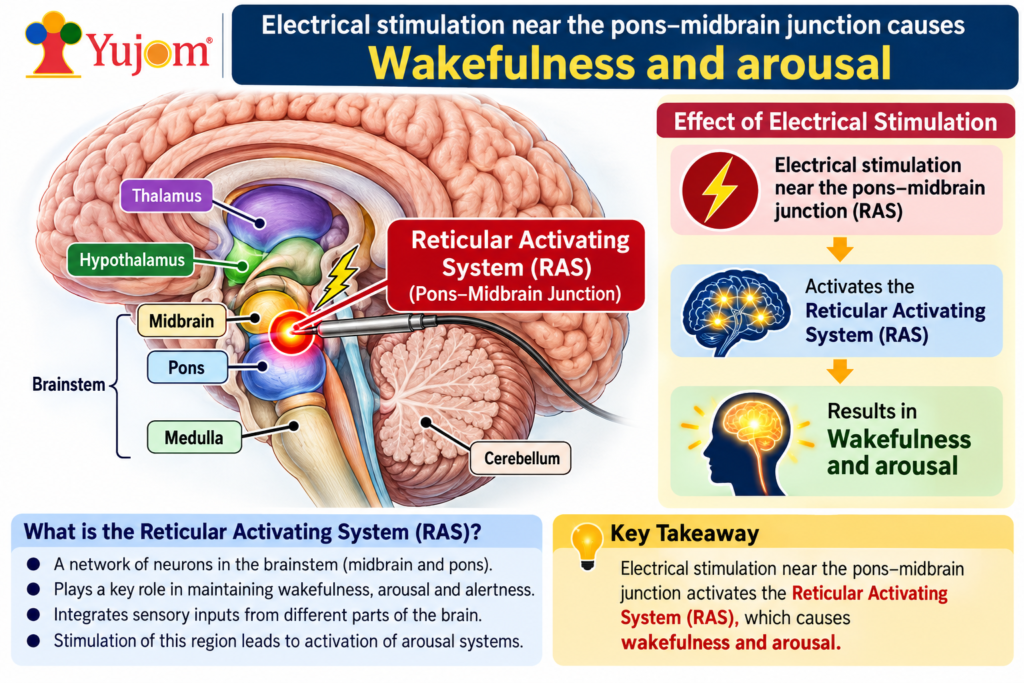
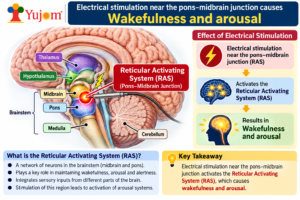
Experimental research has shown that electrical stimulation near the pons–midbrain junction can produce wakefulness and arousal.
The basic relationship can be remembered as:
Electrical stimulation → Reticular Activating System (RAS) → Increased arousal → Wakefulness
The RAS is not a single small structure but a functional network of neurons within the brainstem and related ascending pathways. It helps activate and maintain widespread brain activity necessary for an alert state.
What Is the Reticular Activating System?
The Reticular Activating System (RAS) refers to neural systems involved in regulating the brain’s level of arousal and wakefulness.
Its functions include:
- Maintaining wakefulness and alertness
- Supporting arousal
- Modulating the brain’s response to sensory information
- Helping regulate transitions between sleep and wakefulness
- Supporting the level of cortical activation necessary for conscious awareness
Why Is the RAS Important?
Imagine receiving an important sound while you are becoming drowsy. The brain must determine whether to remain in a low-arousal state or become more alert.
The ascending arousal systems of the brainstem help provide this activation to broader brain networks.
Therefore, the RAS can be understood as part of the brain’s “wake-up and alerting system.”
Pons–Midbrain Junction and Wakefulness
The pons and midbrain are parts of the brainstem. Neural systems in and around these regions contribute importantly to arousal.
This is why the classic experimental finding is significant:
Stimulation near the pons–midbrain junction can promote wakefulness and arousal.
This observation helped neuroscientists understand that maintaining consciousness and wakefulness requires active neural systems, rather than simply the passive absence of sleep.
🧠 Exam Point
For neuroscience and sleep-related examinations, remember:
Pons–midbrain stimulation → Reticular Activating System → Wakefulness & Arousal
Quick Memory Trick
RAS = “Rise and Stay Awake” ⏰🧠
R → Reticular
A → Activating
S → System
Key takeaway: The Reticular Activating System is a major component of the neural machinery supporting wakefulness, arousal, and alertness.
